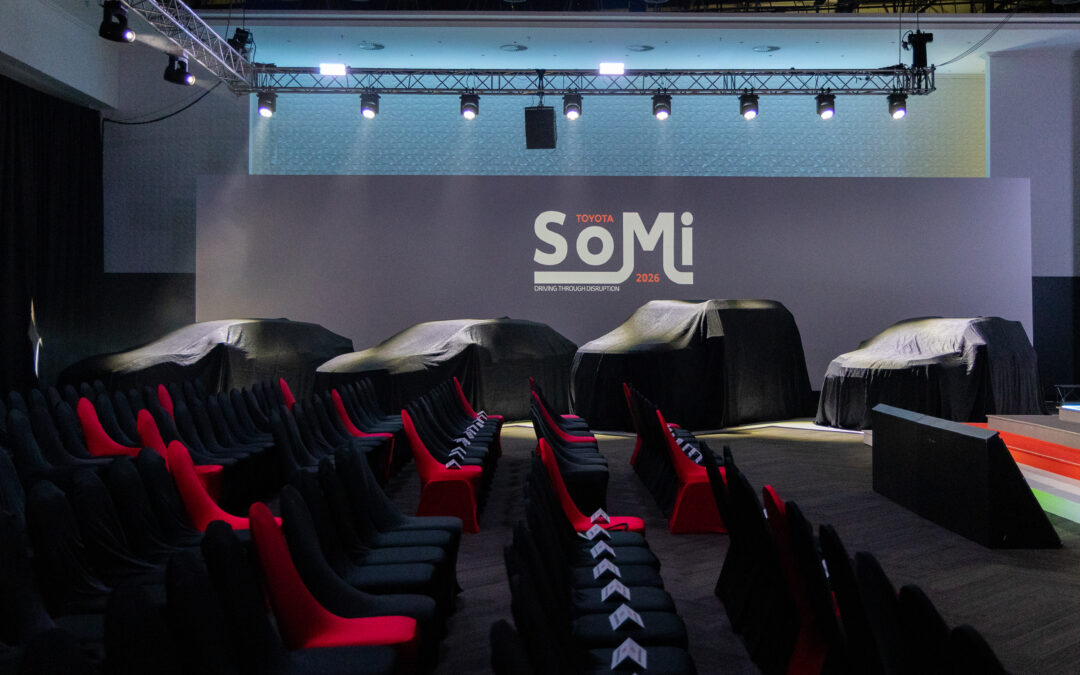
Toyota South Africa Motors (TSAM) hosted its ninth annual State of the Motor Industry (SOMI) event. The event brought together industry leaders, policymakers, media and mobility stakeholders under the timely theme, “Driving Through Disruption.” Under the theme, the event focused on navigating global volatility, strengthening industrial competitiveness and accelerating South Africa’s transition to new energy vehicles.
TSAM President and CEO Andrew Kirby opened the event by welcoming partners across the automotive value chain including NAAMSA, AITF leaders, major component suppliers, dealer representatives and members of the South African media. He expressed gratitude for continued loyalty from customers and industry stakeholders alike. “Our strength as an organisation is built on our suppliers, our dealer network and our interdependent ecosystem. We walk this journey together and we are deeply grateful for the support that continues to move our industry forward,” said Kirby.
Navigating global disruption and local industry performance
Kirby noted that while global and local environments remain highly unpredictable, the industry must adapt faster and more dynamically than ever. “We live in uncertain times – globally and here in South Africa. The question is not whether disruption will come but how we respond to it,” he said. “Driving through disruption requires resilience, curiosity and continuous innovation.”
He emphasised the importance of South Africa’s auto industry to grow its volume adding that however, volume growth needs to go hand in hand with growth in CKD (despite industry growth, CKD has seen a drop). “It is not sufficient to only see volume growth stem from an increase in the entry (affordable) models as this does not have significant GDP impact. We also can’t rely on exports to fill the gap – global regulation and forces will impact where we can export to,” he added.
Kirby highlighted that Toyota South Africa’s focus remains firmly on treating each customer uniquely, shaping products and services around real world needs and usage conditions. Additionally, he reiterated TSAM’s commitment to advancing South Africa’s industrial competitiveness through stable policy, investment in local operations and deeper supply-chain localisation.
Strengthening SA’s industrial competitiveness
Broader industrial challenges continue to surface, including energy costs, logistics constraints, labour costs and rising input costs. South Africa is showing early signs of premature deindustrialisation. Manufacturing value-add per capita has declined over the last two decades, falling behind global peers. “We cannot become a purely import-driven market. With the right small policy adjustments, we can strengthen competitiveness, attract new investment and grow the economy,” said Kirby.
Policy clarity for a pragmatic, multi‑pathway transition
Kirby welcomed the European Union’s revision of its 2035 target from a 100% to a 90% emissions reduction for new cars/vans, which allows ICE and hybrid vehicles to remain in the mix beyond 2035 if powered by low‑carbon fuels or offset through other decarbonisation levers (e.g., e‑fuels, biofuels, low‑carbon steel).
By contrast, South Africa currently has no NEV target or regulatory framework, though additional investment support for BEVs and FCEVs comes into effect in April. Kirby stressed that countries accelerating NEV adoption are doing so through clear regulatory signals and targeted incentives.
“South Africa must set clear goals and supportive policies aligned to global trends to accelerate NEV adoption in support of our 2050 net‑zero commitments,” he urged. “The fastest way to reduce near‑term emissions is with HEVs, complemented by PHEVs – which offer practical benefits in our usage conditions – and a growing role for BEVs as charging infrastructure and total cost of ownership improve. Our drivetrain mix will be determined by customer value, infrastructure readiness and use cases.”
“We must not simply defend what we have – we must grow. This industry has built deep capabilities over 100 years. With decisive leadership, collaboration and smart interventions, we can secure the next era of automotive manufacturing in South Africa,” concluded Kirby